Most people have heard some version of the same message: iodine is good for the thyroid, so more must be better. That sounds reasonable on the surface, but for many people with thyroid disease, it is exactly where trouble begins.
When it comes to thyroid disease management, iodine is not like most nutrients. The difference between getting enough and getting too much is surprisingly small. And if you have Hashimoto’s, Graves’ disease, or even a family history of thyroid problems, that margin gets even tighter.
This is where a lot of confusion comes from. Yes, iodine deficiency can cause thyroid problems. But that does not mean all thyroid problems come from low iodine. In the modern world, most adults are not short on iodine. In fact, many are dealing with iodine excess without realizing it.
If your labs seem erratic, your thyroid antibodies are climbing, or you are doing all the “right” things and still not feeling better, excess iodine may be one of the missing pieces.
In my practice, I’ve seen this pattern show up repeatedly in people who are doing everything else right.
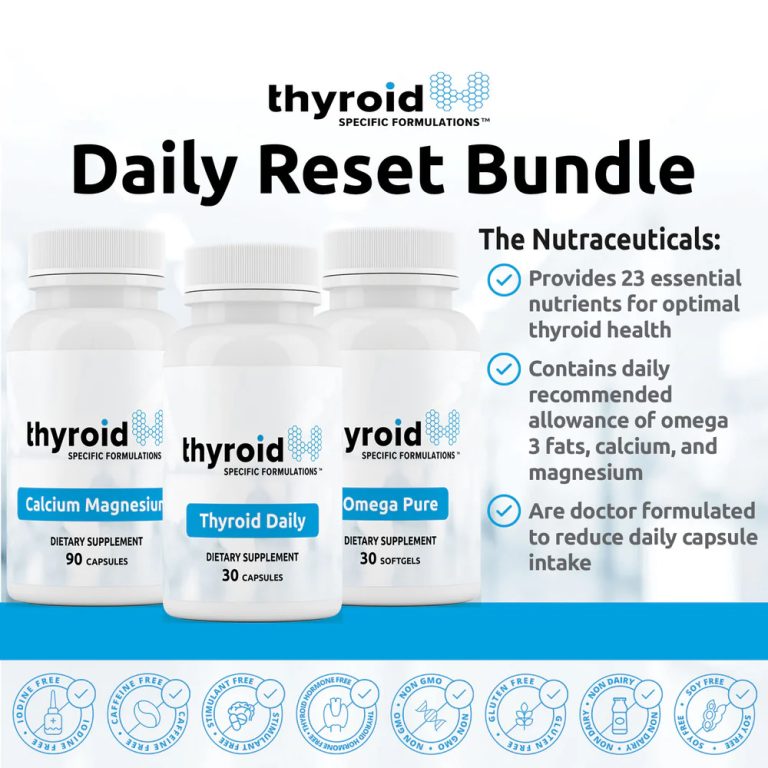
Recommended Product: Daily Reset Bundle. It is the daily routine I formulated for people living with Hashimoto’s, hypothyroidism, Graves’ disease, or life after thyroid surgery. Three targeted products that support your body’s ability to use thyroid hormone effectively, protect the systems that thyroid conditions place extra demands on, and help you feel the difference that the right foundation makes. Click Here
Table of Contents
Many nutrients have a broad safety range. Vitamin C is a classic example. A very small amount prevents deficiency, and much larger amounts are still often tolerated well. Iodine does not work that way.
With iodine, there is a relatively narrow window between enough and too much. For people who are genetically more vulnerable to thyroid autoimmunity, that window may be narrow enough that even modest overexposure can cause problems.
That is especially important in the context of Hashimoto’s and iodine. What may be completely fine for someone without thyroid disease may be enough to aggravate symptoms, disrupt lab values, or worsen autoimmune activity in someone with an already sensitive thyroid.
–Key takeaway: For people who are genetically vulnerable to thyroid autoimmunity, the window between enough and too much iodine is very narrow, and overexposure can aggravate symptoms or worsen autoimmune activity.
One of the clearest signs of iodine excess is a rise in TPO antibodies, especially when you are otherwise trying to support your thyroid carefully.
TPO stands for thyroid peroxidase. This enzyme plays a central role in thyroid hormone production because it helps oxidize iodine. When iodine intake goes above what the body can comfortably process, thyroid peroxidase can become a target of the immune system.
That is why there is such a strong connection between excess iodine exposure and rising TPO antibodies. The more iodine that has to be processed, the more immune activation can occur against that enzyme.
For anyone dealing with autoimmune thyroid disease, this matters a lot. If your antibody levels are increasing and you cannot figure out why, it is worth taking a serious look at all your iodine sources before assuming you need more iodine, not less.
Another less obvious clue is a low T3 to T4 ratio. In practical terms, this often looks like adequate T4 with low or low-normal T3.
This pattern can suggest that your body is not converting thyroid hormone efficiently. One reason that may happen is that the enzyme involved in converting T4 to T3, called type 2 deiodinase, is getting overwhelmed.
This enzyme works with iodine. If there is more iodine circulating than the body needs, the enzyme may not do its hormone-conversion job as effectively because it is too busy handling the extra iodine burden.
That can leave someone with “acceptable” thyroid numbers on paper in some areas, while still feeling sluggish, foggy, or unlike themselves because active T3 is not where it should be.
This is one reason thyroid disease management cannot be reduced to one nutrient or one lab marker. More iodine does not automatically mean better thyroid output. In some cases, it can interfere with the very chemistry needed to make thyroid hormones usable.
If your TSH seems unable to hold steady and swings far more than expected from one test to the next, excess iodine may be part of the story.
This often relates to the Wolff-Chaikoff effect. It sounds technical, but the basic idea is simple. Think of it like a fuse box in a house. Too much electrical current comes through, and the fuse trips. Suddenly the lights go out, not because there is too little power, but because there is too much.
The thyroid can respond in a similar way to too much iodine. Once intake rises above what your body can tolerate, the gland may temporarily shut down hormone production. Paradoxically, too much iodine can act almost like no iodine at all.
That shutdown can last for weeks. During that time, TSH may rise, fall, and behave unpredictably. For someone trying to make sense of repeated thyroid labs, this can be incredibly frustrating.
The key point is that unstable TSH is not always a sign that you need more support. Sometimes it is the opposite. Sometimes it is a warning that your body is trying to protect itself from too much iodine exposure.
This is the sign that surprises people most.
Excess iodine can disrupt gut flora. That may show up as:
Why would that happen?
If the body is taking in more iodine than it needs, more of it can pass through the intestinal tract. Iodine is, after all, a disinfectant. That is one reason it has historically been used on wounds. It is effective at killing bacteria. The problem is that it does not only affect the bacteria you do not want. It can also affect the healthy bacteria you do want in your gut.
This matters because gut health and thyroid autoimmunity are closely connected. Disturbances in the microbiome may be one more mechanism linking iodine excess with autoimmune thyroid disease.
If digestive symptoms worsened after starting kelp, seaweed-based products, new supplements, certain specialty salts, or other concentrated iodine sources, that is not something to ignore.
–Key takeaway: Excess iodine can disrupt healthy gut flora because of its disinfectant properties, potentially causing symptoms like gas and bloating, which connects iodine excess with autoimmune thyroid disease.
Many people think only of iodized salt, but iodine can come from a wide range of places. In real-world thyroid disease management, the total load matters more than any single source.
Possible contributors include:
That is why people often miss the pattern. They are not taking an “iodine supplement” in the obvious sense, but their cumulative intake is still high enough to create problems.
This is where the conversation gets even more important. Many people assume the simplest answer is to test iodine directly. Unfortunately, iodine testing accuracy is a major problem at the individual level.
There are iodine tests that can be useful for studying large populations. Those tests can help researchers understand whether a community, region, or country is generally getting enough iodine. But what works for population data is not the same as what works for one person sitting in a clinic trying to make a treatment decision.
Iodine levels in the body can fluctuate dramatically from one moment to the next. Because of that, a morning urine iodine test or a blood iodine test may look precise, but it does not necessarily provide meaningful individual guidance.
There are some tests that may help identify extreme excess. But according to experts in this area, there is no reliable test that accurately tells an individual whether they are getting too little iodine based on one isolated sample.
That means a result labeled “low iodine” on a blood test or urine test should be interpreted very cautiously. In many cases, it is not valid evidence that someone needs more iodine.
This is one of the biggest traps in Hashimoto’s and iodine. A person with autoimmune thyroid disease gets a test that appears low, starts supplementing iodine, and then their antibodies rise, their TSH becomes erratic, or their gut symptoms flare. The test seemed logical. The outcome was not helpful.
Because iodine testing accuracy is so limited for individuals, the best practical approach is often much simpler: inventory your iodine intake.
In other words, look at your usual week and calculate where iodine is coming from.
That means reviewing:
Once you do that math, you can often get a much more realistic picture of your average intake than any one-time lab test can provide.
This approach is not flashy, but it is practical. And in many cases, it explains why a thyroid that should be stabilizing is not doing so.
If you have thyroid disease, iodine is not something to guess about casually. More is not better. More can be exactly what pushes your thyroid in the wrong direction.
Pay special attention if you notice any of these four patterns:
These can all be clues that iodine excess is playing a role.
For people working through Hashimoto’s and iodine, or anyone trying to improve thyroid disease management, it is worth remembering that precision matters. Iodine is essential, but only within the right range. Once you go beyond that range, the effects can show up in antibodies, hormone conversion, TSH stability, and even digestive health.
The real goal is not high iodine. It is the right iodine amount for your body, your thyroid, and your individual tolerance.
You don’t have to stay stuck. You just need the right information – and now you have a clearer place to start.

P.S. Whenever you are ready, here is how I can help you now:
Dr. Alan Glen Christianson (Dr. C) is a Naturopathic Endocrinologist and the author of The NY Times bestselling Hormone Healing Cookbook, The Metabolism Reset Diet, and The Thyroid Reset Diet.
Dr. C’s gift for figuring out what works has helped hundreds of thousands reverse thyroid disease, heal their adrenals, and lose weight naturally. Learn more about the surprising story that started his quest.